


Most people don’t overspend because they’re reckless. They overspend because they have no system. They buy when they feel like it, react to sales without a plan, and only notice the damage when the bank statement arrives.
A monthly budget shopping guide isn’t about spending less on things you love. It’s about spending deliberately, knowing what you’re buying, when the best time to buy it is, and making sure every purchase has a coupon code, cashback layer, or timing advantage working in your favour.
This guide gives you that system. It covers how to set a realistic monthly shopping budget, how to plan purchases around the best deals of each month, and the specific tools that shave money off your total spend without requiring obsessive deal-hunting. Apply it consistently through 2026 and the savings compound into something genuinely meaningful by December.
Table of Contents
Step 1 – Set a Realistic Monthly Shopping Budget
Before you can stick to a budget, you need one that reflects how you actually shop, not an aspirational number you’ll abandon by the second week.
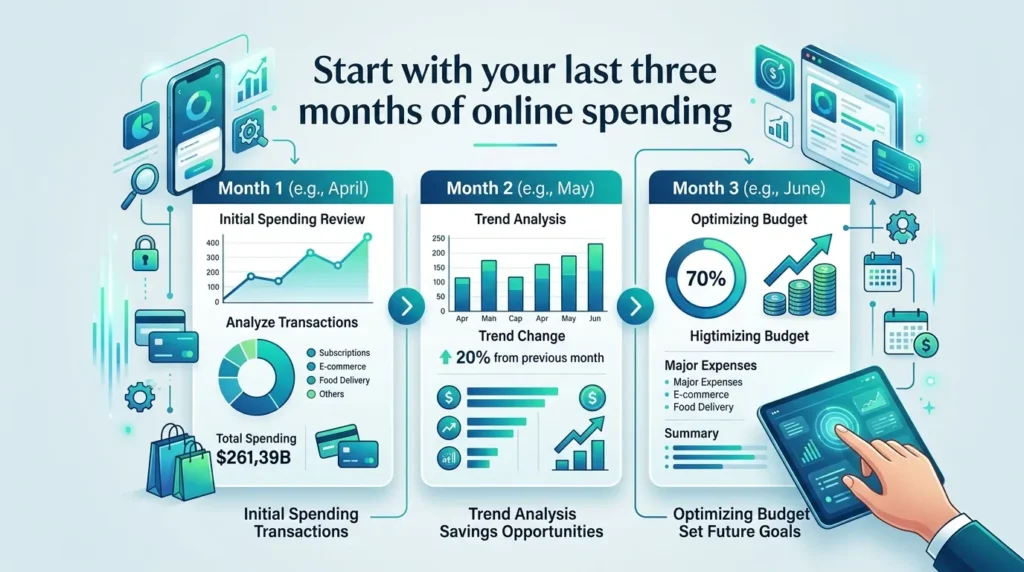
Start with your last three months of online spending
Pull up your bank statements or card history and add up everything spent online across the last three months clothing, electronics, homewares, subscriptions, gifts, everything. Divide by three. That’s your current monthly average. It might be higher than you expected. That number is your starting point, not your ceiling.
Split your budget into categories
Allocating a total monthly budget without category splits is why most shopping budgets fail. You spend it all on clothing in week one and have nothing left for the household items you needed. A simple category split keeps spending balanced:
| Category | Suggested allocation | Notes |
| Clothing & fashion | 20%–25% | Adjust down for minimal-wardrobe shoppers |
| Household & home | 15%–20% | Includes cleaning, décor, kitchenware |
| Electronics & tech | 10%–15% | Lower monthly; save for quarterly splurge |
| Food & groceries | 20%–25% | Includes online supermarket orders |
| Health & beauty | 10%–15% | Subscriptions count here |
| Gifts & occasions | 10% | Smooth out big months — birthdays, Christmas |
| Miscellaneous | 5%–10% | Buffer for unplanned but sensible purchases |
Build in a saving layer from day one
Before finalising your monthly budget total, factor in the saving tools you’ll use consistently: coupon codes, cashback, and a rewards card. If you’re applying a 10%–15% combined saving across your shopping, your effective spend is already lower than your gross budget figure. Set your budget at what you’re willing to spend before savings, then treat the recovered amount as a bonus rather than extra spending room.
Step 2 – Build a Monthly Shopping Calendar
One of the most consistent mistakes budget shoppers make is buying at the wrong time. The same product can vary by 20%–40% in price depending on when in the year you buy it. A monthly shopping calendar turns that knowledge into a plan.
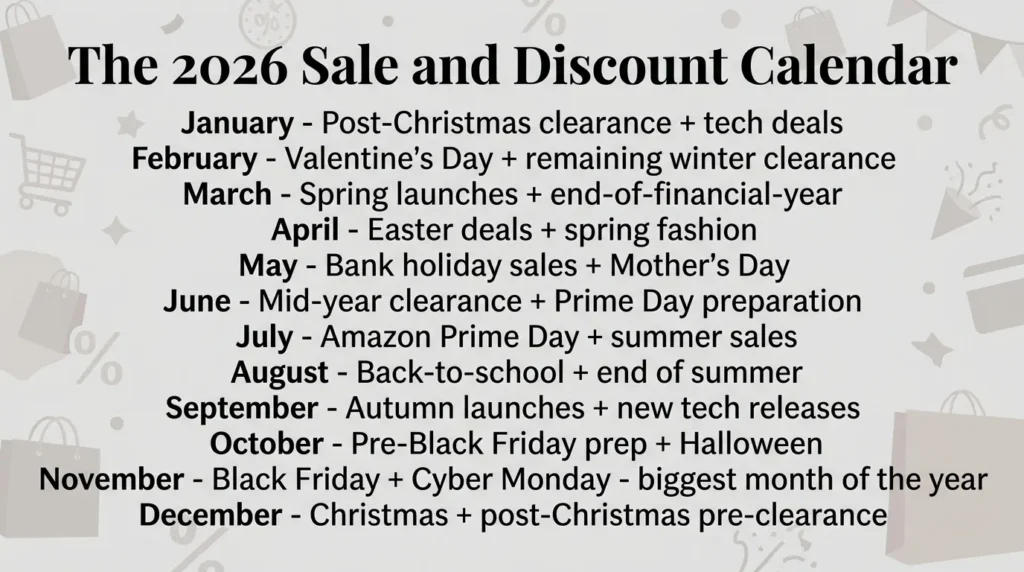
The 2026 sale and discount calendar
Here’s when each product category is cheapest – and what to prioritise each month:
January – Post-Christmas clearance + tech deals
Best month for TVs, large appliances, and furniture as retailers clear end-of-year stock. Winter clothing hits 50%–70% off. Avoid buying spring/summer clothing it’s full price.
February – Valentine’s Day + remaining winter clearance
Beauty, fragrance, and jewellery deals peak mid-month. Final clearance on winter coats and knitwear. Good month for homeware subscriptions many brands run February retention offers.
March – Spring launches + end-of-financial-year
New season stock arrives, but old stock is still clearing. Electronics deals around end-of-financial-year in AU/UK. Easter promotions begin late March – food, gifts, and homeware.
April – Easter deals + spring fashion
Easter weekend typically brings 20%–30% off across fashion and beauty. Good month to buy outdoor furniture and garden equipment before summer demand pushes prices up.
May – Bank holiday sales + Mother’s Day
May bank holidays drive promotions across most categories. Mother’s Day gifting peaks flowers, beauty, and experiences. Good month to stock up on summer essentials before school holiday markups.
June – Mid-year clearance + Prime Day preparation
Retailers begin mid-year clearance. Amazon Prime Day is typically in June or July hold major tech purchases for this window. Summer fashion peaks in price; buy autumn items instead.
July – Amazon Prime Day + summer sales
The single best month for electronics, kitchen appliances, and tech accessories. Summer sales across fashion. School uniform and back-to-school promotions begin stock up early.
August – Back-to-school + end of summer
Best month for stationery, bags, and student essentials. Summer clothing hits clearance. Laptop and tablet deals for students. Hold off on autumn/winter clothing still full price.
September – Autumn launches + new tech releases
New smartphone generations release -buy previous models now for 20%–35% discounts. Autumn fashion arrives full price; winter gear still coming. Good month for sports and gym equipment.
October – Pre-Black Friday prep + Halloween
Halloween drives beauty, costume, and confectionery deals. Begin building a wishlist for Black Friday. Some retailers start early Black Friday promotions. Good month for home improvement purchases.
November – Black Friday + Cyber Monday – biggest month of the year
The deepest discounts of the year across electronics, fashion, beauty, homewares, and toys. Have your wishlist ready before the month starts. Stack coupon codes with cashback for maximum savings. See our stacking guide for the exact process.
December – Christmas + post-Christmas pre-clearance
Gift buying peaks – use coupon codes across all categories. Boxing Day sales begin 26 December and run into January. Avoid panic-buying in the last week before Christmas; prices are highest then.
Planning:
The biggest savings come from buying things before you urgently need them. A coat bought in March for next winter at 60% off is always cheaper than one bought in October at full price. Build a ‘buy ahead’ note in your phone and add to it whenever you spot a seasonal low.

Step 3 – Apply the Pre-Purchase Saving Routine Every Time
Budgeting controls how much you allocate. The pre-purchase routine controls how much of that allocation you actually spend versus recover. These are two separate disciplines and most budget guides only cover the first one.
The routine takes under two minutes and applies to every online purchase regardless of size, but the core steps for budget shoppers are
1. Check for a coupon code before checkout. Search the retailer on TheDiscountEmpire. A working code on even a modest purchase saves 10%–20% instantly.
2. Activate cashback before you visit the store. Click through from Rakuten or TopCashback first. The cashback earns on whatever you pay after the coupon code, two independent saving layers on the same order.
3. Check for a free shipping code if delivery is charged. On smaller budget purchases, shipping can be 15%–20% of the total. Eliminating it is often better than a percentage-off code.
4. Pay with a rewards card. 2%–5% back on every transaction. Passive, effortless, and compounds across a full month of purchases.
Step 4 – Manage Subscriptions and Recurring Costs Monthly
Subscriptions are the silent budget drain of modern online shopping. They auto-renew, they’re easy to forget, and collectively they represent a significant monthly outgoing that most people could reduce by 30%–50% with one annual review.
Audit your subscriptions quarterly
Set a calendar reminder for the first of every quarter: January, April, July, October. On that day, list every active subscription streaming, software, delivery memberships, subscription boxes, apps. For each one, ask: did I use this regularly last quarter? If the answer is no, cancel or pause it.
Negotiate on renewals
Before cancelling a subscription you use moderately, contact the provider and ask what they can offer to keep you. Retention discounts of 20%–40% are common at streaming services, software platforms, and subscription boxes. Most companies would rather discount than lose a customer, especially if you’ve been subscribed for a year or more. The call takes five minutes and frequently pays well.
Use free shipping memberships deliberately
Paid delivery memberships Amazon Prime, ASOS Premier Delivery, and similar only represent value if you shop frequently enough at those retailers to justify the annual fee. Calculate the per-order shipping cost you’d pay without the membership versus the membership price. If you’re ordering fewer than eight to ten times per year from that retailer, individual free shipping codes covered in our free shipping codes guide will usually cost less over twelve months than the membership fee.
Step 5 – Build a Monthly Wishlist to Avoid Impulse Spending
Impulse purchases are the single biggest budget-buster for online shoppers. The friction of in-person shopping travelling to a store, queuing, carrying bags home acts as a natural filter on impulse buying. Online shopping removes all of it. A wishlist system replaces that friction with intentionality.
How the wishlist system works
• Any time you want to buy something non-essential, add it to a dedicated wishlist, not the cart, with today’s date
• Wait at least 48 hours before buying anything from the wishlist. For purchases over $50, wait a week
• After the waiting period, review each item: do you still want it? If yes, proceed with the full pre-purchase routine code, cashback, card
• Items that no longer feel essential after 48 hours go to a ‘maybe’ list. Items that still feel essential after a week are genuine wants worth buying
The 48-hour rule eliminates a significant proportion of impulse spending without requiring willpower. Most impulse buys feel less urgent two days later. The ones that still feel necessary after waiting are almost certainly worth buying and you’ll now buy them with a saving routine applied rather than at full price on a whim.
Use your wishlist to prepare for sale events
A wishlist built over weeks or months becomes your Black Friday and Cyber Monday shopping list. Instead of browsing during the sale and buying whatever appears discounted, you know exactly what you want, you’ve already tracked the prices, and you can act quickly when the discount hits. Pre-planned sale shopping consistently produces better results than reactive browsing.
Step 6 – Review and Adjust Your Budget at Month End
A budget that isn’t reviewed is just a guess. The monthly end-of-month review is what converts a spending intention into a spending habit.
What to review each month
• Actual spend vs budgeted spend by category. Which categories went over? Were they genuine needs or impulse purchases?
• Total savings recovered. How much did coupon codes, cashback, and card rewards actually return? Tracking this number makes the habit feel concrete rather than abstract.
• Subscriptions renewed this month. Were any auto-renewed that you forgot about? Cancel any you don’t plan to use next month.
• Purchases made without checking for a code. Be honest. For each one, check now whether a code was available that you missed. The missed saving is your reminder for next month.
Adjust category allocations based on actual patterns
After two or three months of tracking, real patterns emerge. You might consistently underspend on electronics and overspend on beauty. Adjust the category split to reflect your actual spending patterns rather than keeping idealistic allocations that don’t fit how you live. A budget that fits your real life is one you’ll actually use.
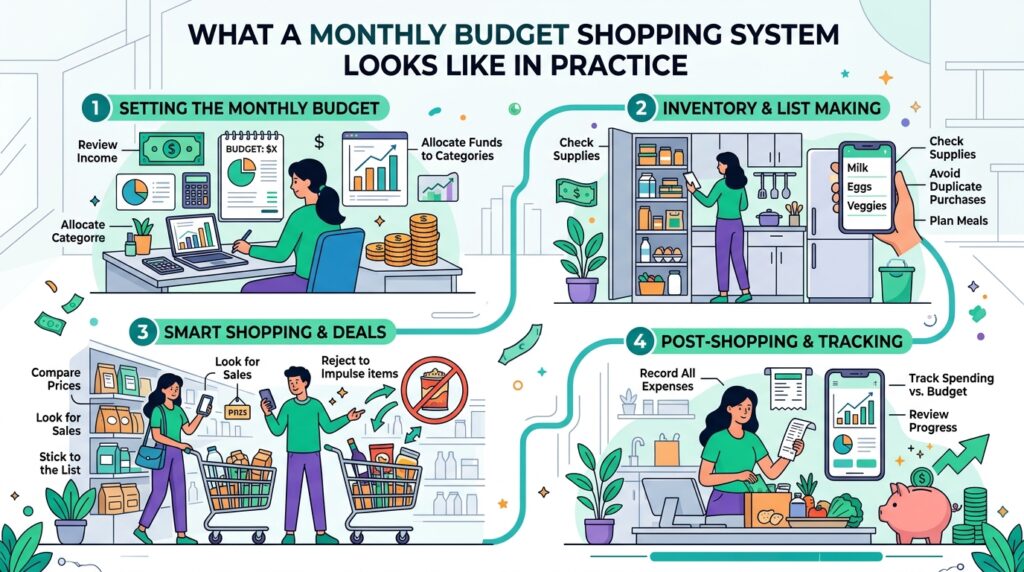
What a Monthly Budget Shopping System Looks Like in Practice
Here’s how a realistic month plays out for a budget-conscious online shopper in 2026, applying everything covered above:
| Week | Action | Tool used | Outcome |
| Week 1 | Check the calendar what’s on sale this month? | Monthly sale calendar above | Identify 2–3 best buying windows |
| Week 1 | Review wishlist any items ready to buy? | Wishlist + 48hr rule | Buy 1 wishlisted item with full routine |
| Week 2 | Mid-month spending check | Bank app/spreadsheet | Confirm within category budgets |
| Week 2 | Apply coupon + cashback to all purchases | TheDiscountEmpire + Rakuten | 10%–20% saving per qualifying order |
| Week 3 | Add new wants to wishlist, not cart | Notes app or wishlist feature | Impulse spending eliminated |
| Week 4 | End-of-month review actual vs budget | Spending tracker | Category adjustments for next month |
| Week 4 | Check cashback balance any ready to withdraw? | Rakuten / TopCashback dashboard | Recover earned cashback |
Final Thoughts
Budget shopping isn’t about buying less. It’s about buying smarter, knowing when to buy, what tools to use before checkout, and which categories to prioritise each month. The system in this guide works because it’s built around real shopping behaviour rather than an idealised version of it.
The monthly sale calendar tells you when. The pre-purchase routine tells you how. The wishlist tells you whether. And the end-of-month review keeps the whole thing honest.
Apply all four and 2026 is the year your online shopping spend produces meaningfully better value than 2025 did without giving up anything you actually want to buy.
Start with TheDiscountEmpire verified coupon codes for hundreds of retailers, updated daily. Make it the first tab you open before every online purchase and the system starts working from your very next order.
FAQs
1. Can I save money on electronics without waiting for major sales?
Yes. While Black Friday and other seasonal events offer good deals, you can still save throughout the year by comparing prices, using verified discount codes, earning cashback, and checking for retailer promotions. A little research before buying often leads to meaningful savings.
2. Are manufacturer warranties valid on discounted electronics?
In most cases, yes. Buying from an authorized retailer or the manufacturer’s official store means your product usually comes with the same warranty, even if you purchased it using a coupon code or during a sale. Always review the warranty terms before placing your order.
3. Is buying electronics online cheaper than purchasing in-store?
It often can be. Online retailers frequently provide exclusive discounts, promotional codes, cashback offers, and price comparison options that may not be available in physical stores. However, comparing both online and local prices is always a smart approach.
4. How can I tell if an online electronics deal is trustworthy?
Buy from reputable retailers, verify seller ratings, check customer reviews, and compare prices across multiple stores. If a deal seems unusually cheap compared to every other retailer, it’s worth investigating before making a purchase.
5. Do discount codes work on newly released electronics?
Usually, newly launched electronics have fewer promotional offers because demand is high. However, some retailers may provide limited-time welcome discounts, student offers, financing promotions, or cashback deals that can still help reduce your overall cost.