
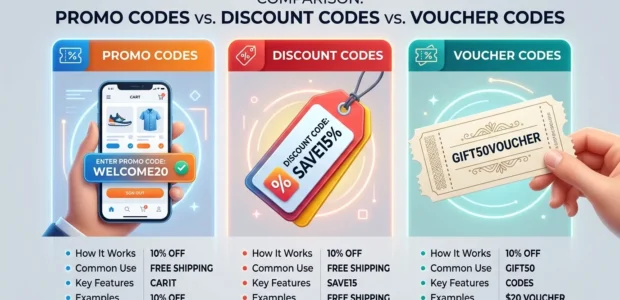

If you’ve spent any time shopping online, you’ve seen all three: promo codes, discount codes, voucher codes. Sometimes they appear on the same checkout page. Sometimes stores use the terms interchangeably. And occasionally, you’ll find yourself staring at a box labelled “Enter voucher code” while holding what the store called a “promo code” and wondering if they’re the same thing.
The honest answer is: mostly yes, but the details matter. There are meaningful distinctions between these terms, distinctions that affect where you find them, how you apply them, and what kinds of savings they deliver.
This guide clears up the confusion for good. By the end, you’ll know exactly what each term means, when each type of code is used, and how to find them. If you want the practical side of applying codes at checkout, our step-by-step coupon codes guide covers that in full.
Table of Contents
The Quick Answer — Are They Different?
In most cases, promo codes, discount codes, and voucher codes all do the same thing: they reduce the price of your order when entered at checkout. The differences are mainly about:
• The terminology preferences of different regions (UK vs US, for example)
• The specific type of saving being offered
• How and where the code was issued
• Whether the code is digital-only or has a physical equivalent
Think of them as three slightly different flavours of the same thing like calling something a “biscuit” in the UK and a “cookie” in the US. The underlying object is the same; the name reflects context.
That said, there are real distinctions worth understanding, especially if you’re hunting codes across different platforms or regions.
What Each Term Actually Means
Promo code
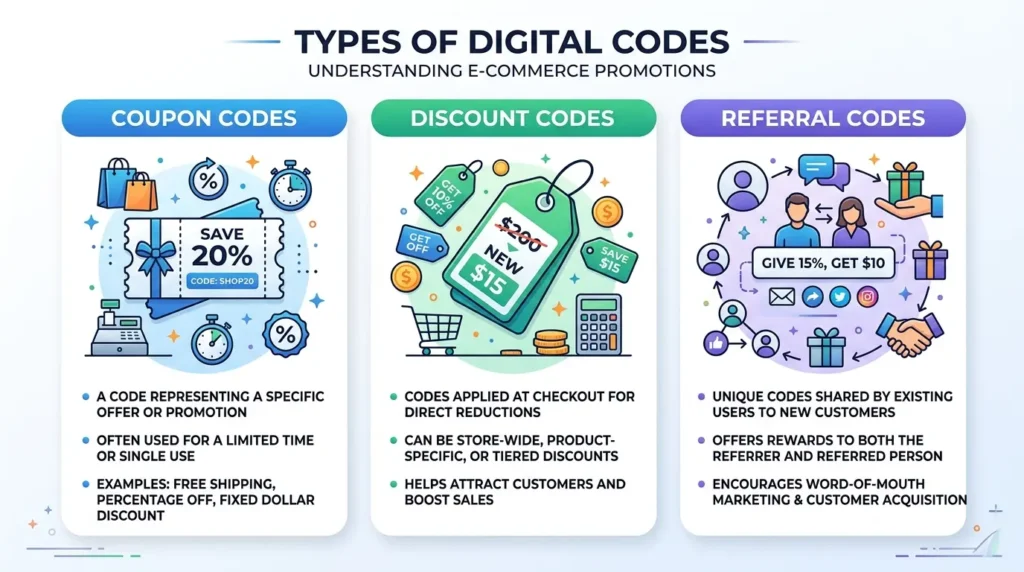
Short for promotional code. A string of letters and/or numbers issued as part of a marketing campaign. Entered at checkout to unlock a discount, free shipping, or a special offer tied to a specific promotion.
Discount code
A general term for any code that reduces the price of an order. Often used interchangeably with promo code. Tends to refer to percentage-off or flat-amount-off codes rather than shipping or gift offers.
Voucher code
More common in the UK and Australia. Traditionally referred to a physical paper voucher that could be redeemed in-store, but now almost always means a digital code used online. Often used by UK retailers to describe the same thing an American site would call a promo code.
Coupon code
The broadest term, especially common in the US. Derived from traditional paper coupons. Covers all types of promotional codes percentage off, free shipping, BOGO, and others. Most coupon sites use this as the umbrella term for everything.
Referral code
A specific type of promo code tied to a referral programme. One customer shares a unique code; when a new customer uses it, both parties receive a reward. Technically a subset of promo codes but functions differently, the code is personalised and single-use.
Why the Terminology Differs by Region
A lot of the confusion between these terms comes down to geography. Here’s how the language breaks down:
| Term | US usage | UK usage | AU usage |
| Promo code | Very common | Common | Common |
| Discount code | Common | Common | Common |
| Voucher code | Rarely used | Very common | Very common |
| Coupon code | Most common | Less common | Less common |
| Referral code | Common | Common | Common |
TheDiscountEmpire serves both US and UK shoppers, so you’ll see a mix of terminology across the site. Whether a code is labelled a promo code, discount code, or voucher code, it works the same way at checkout.
Types of Codes — What They Actually Offer
Beyond the naming differences, codes vary much more meaningfully by what they actually give you. Here’s the complete breakdown of code types by offer:
| Code type | What it gives you | Best for | Stackable? |
| Percentage off | e.g. 20% off your entire order | Large or multi-item carts | Sometimes |
| Flat amount off | e.g. $10 off orders over $50 | Orders near the minimum threshold | Rarely |
| Free shipping | Removes delivery charges | Lightweight or low-value orders | Often yes |
| BOGO | Buy one, get one free or at a discount | Stocking up on repeat-buy items | Rarely |
| Gift with purchase | Free item added to your cart | Trying a new product at no risk | Usually yes |
| Early access | Shop a sale before it opens to the public | High-demand or limited stock | N/A |
| Loyalty reward | Exclusive discount for returning customers | Stores you shop at regularly | Sometimes |
| Referral reward | Credit or discount for referring a new buyer | Sharing with friends and family | Usually yes |
Understanding code types matters more than understanding terminology. A “free shipping promo code” and a “20% off voucher code” are both codes but they deliver very different value depending on your order size and content.
Where Each Type of Code Comes From
Different code types appear in different places. Knowing where to look for each one saves time and increases your success rate:
Promo codes
Issued by stores as part of marketing campaigns, email blasts, influencer partnerships, seasonal promotions, or paid advertising. They’re time-limited by design and often broadcast widely, which also means they expire quickly once a campaign ends. You’ll find them on coupon sites, in marketing emails, and on social media.
Discount codes
The broadest category is found in all the same places as promo codes but also generated automatically in response to shopper behaviour (like abandoned cart sequences) or customer service interactions. Our guide on why codes expire covers the full range of where legitimate codes come from and how long they tend to last.
Voucher codes (UK & AU)
In the UK, voucher codes are often distributed through dedicated voucher sites like MoneySavingExpert, Vouchercodes.co.uk, and TheDiscountEmpire. They’re also issued directly by retailers through their own email lists and loyalty programmes. The term “voucher” in UK retail has strong offline associations physical voucher books and mail-delivered codes — but online it functions identically to any promo code.
Referral codes
These come from existing customers who share a unique link or code with friends. They’re not found on coupon sites because they’re personalised the code is generated for a specific user and tied to their account. If someone shares a referral code with you, it’s designed to be single-use and tied to new customer status.
Coupon codes (US-dominant)
Found on coupon aggregator sites, in print advertisements, and through brand partnerships. TheDiscountEmpire functions as a coupon site in this sense — a centralised hub where working codes from across hundreds of retailers are listed in one place. The advantage over searching Google is that the codes have been reviewed, reducing the chance of hitting dead codes at checkout. See our guide to finding working coupon codes for the full sourcing strategy.
Does It Matter Which Term the Checkout Uses?
No – and this is worth being clear about. Whether the checkout field on a store’s website says:
• “Enter promo code”
• “Enter discount code”
• “Enter voucher code”
• “Enter coupon code”
• “Apply promotional code”
• “Have a gift card or code?”
…they all accept the same format of code and all work the same way. The field label is just the retailer’s preferred terminology for their market. A UK-based code labelled a “voucher code” will work perfectly on a checkout that says “Enter promo code” and vice versa.
The practical steps are always the same: find your code, copy it carefully, paste it into the field, and click apply. Our step-by-step coupon codes guide walks through exactly what to do and what to check when a code doesn’t apply as expected.
Which Type of Code Saves You the Most?
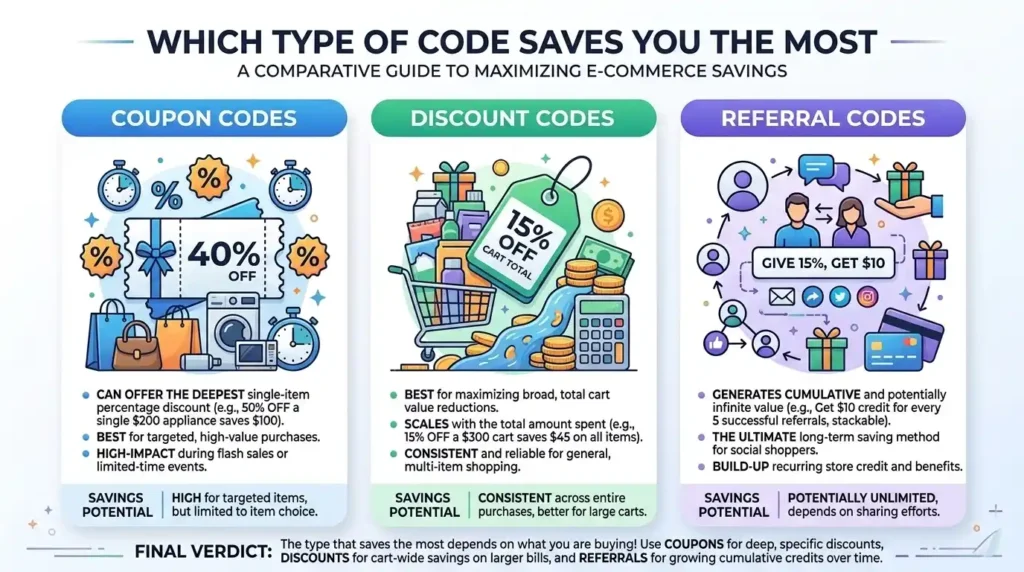
This depends almost entirely on your order. Here’s how to think about it:
For large orders with multiple items
A percentage-off code (e.g., 20% off) delivers the highest savings in absolute terms. The bigger your cart, the more a percentage discount is worth.
For small orders with high shipping costs
A free shipping code can outperform a 10% or even 15% discount code if shipping represents a large slice of the total. On a $30 order with $8 shipping, eliminating delivery effectively represents a 27% savings on the total cost.
For orders just above a spend threshold
Flat-amount codes (“$15 off orders over $75”) are most valuable when your cart is close to the minimum. If your basket is $80, a $15 flat-off code gives you an 18.75% effective discount, often better than a 10% percentage-off code on the same order.
When you can stack
When the store allows it, combining a percentage-off promo code with a free shipping voucher code gives you savings on both. See our coupon stacking guide for the exact process.
Final Thoughts
Promo codes, discount codes, and voucher codes are largely the same thing with different names the terminology varies by region, retailer preference, and the type of saving on offer. What matters far more than the label is the type of saving it delivers and whether it applies to your specific cart.
When you see any of these terms at checkout, treat them identically. Find the best available code for the store, copy it accurately, and paste it in. The field accepts them all.
TheDiscountEmpire lists all code types across hundreds of retailers in one place promo codes, discount codes, voucher codes, and more, organised by store so you can find what you need in seconds before every checkout. Bookmark it and check it before you buy anywhere online.
FAQS
1. What is the difference between a promo code and a discount code?
There is very little difference between a promo code and a discount code. Both are used during checkout to reduce the total cost of an order. The main distinction is the wording retailers choose to use. “Promo code” is often associated with marketing campaigns, while “discount code” is a more general term for any code that provides savings.
2. Are promo codes, voucher codes, and coupon codes the same?
In most cases, yes. All three can unlock discounts, free shipping, or special offers at checkout. The biggest difference is regional terminology. “Coupon code” is more common in the United States, while “voucher code” is widely used in the United Kingdom and Australia.
3. Which type of discount code saves the most money?
The best code depends on your order. Percentage-off codes usually provide the biggest savings on expensive purchases, while free shipping codes can be more valuable for smaller orders with high delivery fees. Comparing the actual savings before checking out helps you choose the best offer.
4. Can I use more than one promo code on the same order?
It depends on the retailer’s policy. Some online stores allow coupon stacking, which lets you combine offers such as a percentage discount with free shipping. However, many retailers only allow one promotional code per order, so it’s always worth checking the store’s terms and conditions.
5. Why isn’t my promo code working?
A promo code may not work because it has expired, requires a minimum purchase amount, is only valid for specific products, is restricted to new customers, or cannot be combined with another promotion. Double-check the code’s terms and make sure it has been entered exactly as provided.
Pingback:What Is a Promo Code and How Does It Work - TheDiscountEmpire.com
Pingback:20 Proven Money-Saving Tips for Online Shopping in 2026 - TheDiscountEmpire.com