

Not every deal you see online is a real deal. And not every coupon code you find will actually save you money. In 2026, the internet is full of fake discount codes, inflated prices dressed up as sales, and scam websites that look like legitimate stores.
The good news is that fake deals are not hard to spot once you know what to look for. There are clear warning signs that separate a genuine saving from a trick designed to make you spend more or hand over your personal information. Before claiming any offer, it’s worth taking a moment to find the Best Online Deals Every Day in 2026 from trusted sources that verify coupon codes and promotions before they are published.
This guide teaches you exactly how to recognise fake discount codes and deal scams, what to do when you find one, and where to go instead so you always get discounts that are real, verified, and actually work at checkout.
Table of Contents
Why Fake Deals and Discount Scams Exist
Before we get into how to spot them, it helps to understand why fake deals exist in the first place. There are three main reasons:
To make money from coupon site traffic
Many coupon websites make money through affiliate commissions. Every time someone clicks from their site to a store, even if they click on an expired code, the site might still earn a fee. So there is no financial reason for these sites to remove old codes. They just pile them up, whether they work or not.
To steal your personal information
Some fake deal sites are designed to collect your email address, phone number, or payment details. They offer an amazing deal that does not actually exist. When you try to claim it, you are asked to fill in a form with your personal information. The deal never materialises. Your information gets sold.
To make you think you are saving when you are not
Some retailers inflate the original price of a product before running a sale. A sofa listed at ‘$1,200 now $600’ sounds like 50% off. But if that sofa was always sold for $600 and the $1,200 figure was only briefly advertised, you are not saving anything. This is called price anchoring and it is used widely by online stores to create the illusion of a discount.
The scale of the problem: Studies suggest that a large percentage of ‘sale’ prices in online retail are based on inflated reference prices that were rarely or never actually charged. And outdated coupon codes make up the majority of results on generic Google searches for discount codes. This is exactly why verified sources matter so much.
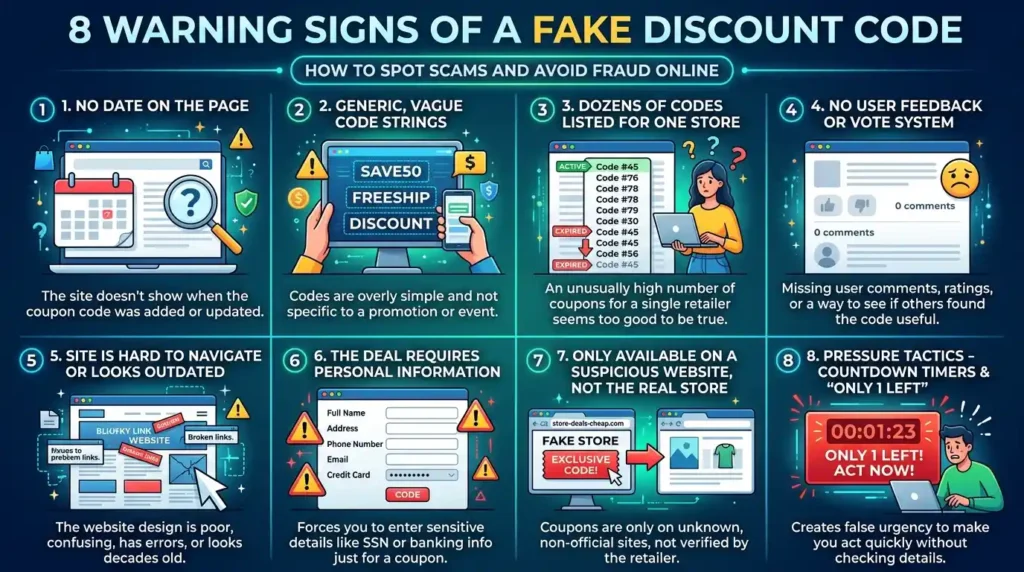
8 Warning Signs of a Fake Discount Code
These are the clearest signs that a coupon code you have found online is not genuine:
1. No date on the page
If a coupon site shows a code but gives no information about when it was added or last verified, you have no way of knowing if it is current. Genuine coupon sites always show a verification date or a “last checked” timestamp. No date means the code was likely added months or years ago and may have expired long since. If you want to combine coupon codes with cashback savings, read How Does Rakuten Cashback Work? to understand how legitimate cashback programs operate.
2. Generic, vague code strings
Codes like ‘SAVE10’, ‘DISCOUNT20’, or ‘COUPON15’ are often recycled placeholder codes from old promotional materials. Real, active coupon codes are usually more specific they include the store name, a campaign reference, or a date. Vague generic codes rarely work.
3. Dozens of codes listed for one store
A legitimate coupon site that actively maintains its listings will typically show three to eight working codes for a store at any given time. A site showing forty or fifty codes for one store is almost certainly displaying every code ever issued by that retailer, including ones that stopped working years ago.
4. No user feedback or vote system
Trustworthy coupon communities let users vote on whether a code worked or report it as expired. If a site has no mechanism for users to flag dead codes, there is no quality control. Every code stays listed forever regardless of whether it works.
5. The site is hard to navigate or looks outdated
Scam coupon sites and low-quality aggregators are often poorly designed — cluttered, full of pop-up ads, or difficult to use. The design quality of a coupon site is a reasonable signal of whether the team behind it actually maintains the codes it lists.
6. The deal requires you to fill in personal information
A real discount code never requires you to hand over your email address, phone number, or payment details just to access the code. If a site asks you to ‘register’ or ‘complete a survey’ before showing you the code, close the tab. This is a data harvesting technique, not a real discount.
7. The deal is only available on a suspicious website, not the real store
Some scam sites copy the look and feel of well-known retailers. They advertise huge discounts on branded products. When you try to buy, you are purchasing from a fake store that will either never ship the item or send a counterfeit. Always check the website address (URL) carefully. Real retailers have recognisable web addresses. A site selling Nike products but with a URL like ‘nikediscounts-outlet.biz’ is a red flag.
8. Pressure tactics – countdown timers and ‘only 1 left’ warnings
Countdown timers that reset each time you visit the page, and ‘only 1 left in stock’ notices that appear even on products that never sell out, are fake urgency tactics. They are designed to make you buy quickly before you think carefully. Real limited-time deals do exist but they do not reset.
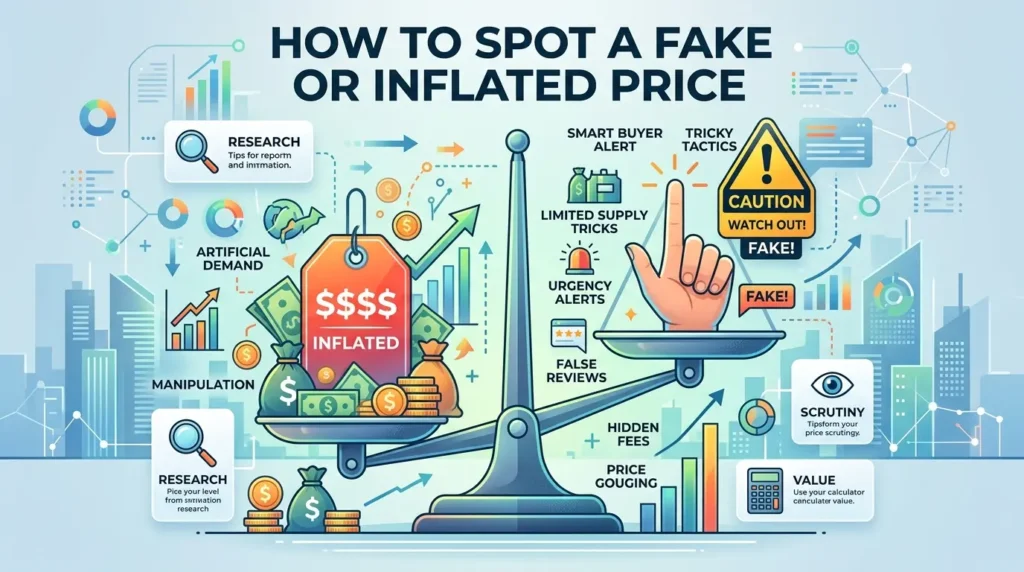
How to Spot a Fake or Inflated Price
Fake discount codes are one problem. Fake sale prices are another. Here is how to tell whether a ‘deal’ on a product is genuine or just a marketing trick.
Check the price history
This is the most powerful tool available to any online shopper. Price tracking tools show you how a product’s price has changed over time. If the current ‘sale price’ is lower than the price was three or six months ago, it is a genuine deal. If the price was mostly at the ‘sale’ price all along and was only briefly raised to create the illusion of a markdown, it is fake.
The best price history tools are:
• CamelCamelCamel — tracks Amazon price history. Paste a product URL and see a full graph of price changes over months or years.
• Google Shopping — shows a price history graph directly on product listings when you search in Google Shopping.
• PriceRunner / PriceSpy (UK) — tracks prices across UK retailers with historical charts. Useful for electronics and home goods.
Compare across multiple retailers
If a product is genuinely discounted, other retailers will often be selling it at a different price making the deal easy to confirm. If every retailer has the same ‘sale price’, the item probably was not discounted at all the ‘sale’ price is just the standard market price with a fake original listed beside it.
Check review dates on the product
If a product page shows reviews from the last few months that discuss the normal price as being the same as the current ‘sale price’, the sale price is not a genuine saving. Real reviews from regular shoppers who paid the full original price would reference that higher number.
Quick test: Before buying anything on sale, ask yourself: ‘Was this product actually ever sold at the higher price for an extended period?’ If the price history shows no — the item was at the sale price most of the time it is a fake markdown. Walk away or check a competitor.
How to Avoid Coupon Code Scam Websites
Some websites are designed specifically to look like legitimate coupon sites but are actually built to harvest your data or earn money from your clicks without giving you anything useful. Here is how to tell the difference:
| Feature | Legitimate coupon site | Scam or low-quality site |
| Code verification | Each code shows a verification date | No dates — or dates are years old |
| Code removal | Expired codes are removed promptly | Dead codes stay listed forever |
| User reviews | Users can vote and report expired codes | No feedback system at all |
| Number of codes | 3–10 active codes per store | 40+ codes with no expiry info |
| Personal data required | No — codes shown directly | Yes — email or survey required |
| Site quality | Clean, maintained, easy to use | Cluttered, ad-heavy, poorly designed |
| Transparency | Clear sourcing and update policy | No information on how codes are found |
TheDiscountEmpire falls clearly in the legitimate column codes are tested, verified, and removed when they stop working. It is the starting point we recommend before every online purchase for exactly this reason.
5 Types of Online Deal Scams to Watch Out For in 2026
Beyond fake coupon codes, here are five specific deal scams that are particularly common in 2026:
1. The Fake Luxury Goods Store
A website selling designer handbags, trainers, or watches at 70% to 80% off. The products look real in the photos. The website looks professional. But when the item arrives, if it arrives at all, it is a low-quality fake. Always buy luxury goods directly from the brand’s official website or an authorised retailer.
2. The Phishing ‘Exclusive Deal’ Email
An email that appears to come from a well-known store – Amazon, ASOS, Walmart offering an exclusive deal or telling you that you have won a prize. The email contains a link that takes you to a website that looks like the real store but is actually fake. It collects your login details or payment information. Always check the sender’s email address carefully. If it does not match the official domain exactly, it is a scam.
3. The Social Media Giveaway Scam
A post on Instagram or Facebook offering a massive prize, a free iPhone or a $500 gift card, in exchange for sharing the post and following the account. These are almost always fake. Real brand giveaways are run on the brand’s verified official account, clearly labelled as a promotion, and have transparent entry terms.
4. The Subscription Trap
A site offers a product for free or at a very low price. You pay only a small shipping charge. But buried in the fine print is a subscription that begins charging you a much larger amount monthly, sometimes starting the very next month. Always read the full terms before entering payment details on any site offering a free or very cheap trial.
5. The Fake Browser Extension
A browser extension that claims to find and apply coupon codes automatically but is actually spyware or adware that tracks your browsing, injects fake prices to make you think you are getting a deal, or redirects your purchases through an unauthorised affiliate link. Only install browser extensions from well-known, reviewed sources. Honey, Capital One Shopping, and Rakuten are safe. Unknown extensions with few reviews are not.
What to Do If You Have Already Been Scammed
If you think you have fallen for a fake deal or a scam website, here is what to do straight away:
1. Contact your bank or card provider immediately
If you entered payment details on a suspicious site, call your bank. Ask them to monitor for unauthorised transactions and consider requesting a new card number. Most banks can reverse fraudulent charges if reported quickly.
2. Change your password if you used an account
If you logged in to anything using a password, even an email address, on a suspicious site, change that password immediately. If you use the same password anywhere else, change it there too.
3. Report the scam website
In the UK, report to Action Fraud at actionfraud.police.uk. In the US, report to the FTC at reportfraud.ftc.gov. Reporting helps get the site taken down and protects other shoppers.
4. Check your email account for any sign-in alerts
If the site captured your email and password, scammers may try to access your email account. Check your recent sign-in activity and enable two-factor authentication if it is not already on.
5. Dispute the charge with your bank if you were billed
Most card providers allow you to dispute a transaction within 60 to 120 days of the charge. Gather evidence screenshots of the website and your order confirmation and contact your bank to open a dispute.
Act fast: The sooner you act after a scam, the better your chances of recovering your money and protecting your accounts. Do not wait to see what happens contact your bank the same day.
Where to Find Deals That Are Genuinely Real
Now that you know what to avoid, here is where to find deals and discount codes you can actually trust:
1. TheDiscountEmpire – Verified Codes Only
Codes on TheDiscountEmpire are tested before being listed and removed when they expire. There are no dates from three years ago. No forty-code lists full of dead codes. No personal information required to see a code. Just verified, working discounts organised by store. It is the first place to check before any online purchase.
2. The Retailer’s Own Website
If a store is currently running a promotion, it will be advertised on their own homepage in a banner, a pop-up, or a header bar at the top of the page. Codes shown here are 100% genuine because the store is actively promoting them. This is the most reliable single source of all.
3. Your Inbox – Codes From the Store Directly
Codes sent to you by a retailer’s own email marketing system are always genuine. Welcome codes, loyalty rewards, birthday discounts, and sale announcements from a store’s email list are fresh, real, and ready to use. Set up a dedicated shopping email address and check it before buying from any store you subscribe to.
4. Deal Communities With Active User Voting
Sites like Slickdeals (US) and HotUKDeals (UK) rely on community members to post and vote on deals in real time. A deal with hundreds of recent ‘thumbs up’ votes and recent comments confirming it works is as verified as a deal gets because real people with nothing to gain are independently confirming it.
5. Cashback Platforms Rakuten and TopCashback
Cashback platforms partner directly with retailers. The cashback rates shown on these platforms are confirmed by the retailers themselves not scraped or estimated. Rakuten and TopCashback both maintain direct commercial relationships with the stores they list, making their offers reliable by design.
A Quick Checklist – Is This Deal Real?
Before you trust any deal or discount code online, run through these five quick questions:
| Question to ask | If YES | If NO |
| Was the code recently verified on a trusted site? | Good sign — try the code | Check TheDiscountEmpire instead |
| Does the price history confirm the sale is genuine? | Good sign — real discount | Possible inflated price — check history |
| Can I find this deal on the retailer’s own site? | Best sign — definitely real | Treat with caution |
| Does the deal require personal info to access? | No = safe to proceed | Yes = walk away — likely a scam |
| Have real users confirmed it works recently? | Yes = high confidence | No = assume it may be dead or fake |
Final Thoughts – Stay Safe and Save Real Money
Fake discount codes and deal scams are a real problem in 2026. But they are avoidable once you know the warning signs. A deal that requires your personal information before you can see it is not a deal. A countdown timer that resets is not urgency. And a site with forty codes and no dates has almost certainly not verified any of them.
The safest approach is simple: stick to sources that verify their claims. TheDiscountEmpire checks and updates its codes so you don’t waste time at checkout on dead links. Your retailer’s own website shows you real current promotions. And price history tools tell you in 60 seconds whether a sale price is genuine.
Saving money online is absolutely possible and very rewarding when done right. The key is finding real deals from honest sources rather than chasing codes that were never going to work.
Start every purchase at TheDiscountEmpire with verified codes, real savings, updated every day.
FAQ
How can I check if a coupon code is still active before using it?
The easiest way is to use a trusted coupon website that regularly verifies and updates its codes. You can also test the code during checkout before completing your purchase. If the discount is applied without errors, the code is active. If it fails repeatedly, it has likely expired or no longer meets the promotion’s conditions.
Why do some discount codes work for other shoppers but not for me?
Many coupon codes have restrictions that are not immediately obvious. They may only apply to selected products, first-time customers, minimum order values, specific countries, or limited promotional periods. Always read the terms and conditions before assuming a code is invalid.
Are browser extensions that automatically apply coupon codes always safe?
Not all of them. Well-known extensions with strong reputations and positive reviews are generally safer than unknown alternatives. Before installing any extension, check its developer, user ratings, permissions, and privacy policy to ensure it does not collect unnecessary personal data.
What should I do if a website offers an unbelievable discount?
Treat extremely large discounts with caution, especially if they seem far lower than prices offered by other retailers. Verify the retailer’s reputation, check independent customer reviews, confirm the website uses HTTPS, and compare prices on multiple trusted stores before making a purchase.
Can expired discount codes become active again?
Yes, some retailers reuse promotional codes during seasonal sales or recurring marketing campaigns. However, there is no guarantee that an old code will become valid again. It’s always better to look for recently verified offers instead of relying on expired promotions.
Pingback:Best Deal Alert Apps and Sites in 2026 - Never Miss a Bargain Again - TheDiscountEmpire.com
Pingback:Flash Sale Guide - How To Never Miss a Limited-Time Deal
After exploring a handful of the articles on your blog, I truly appreciate your technique of writing a blog.
I saved as a favorite it to my bookmark webpage list and will be checking back soon. Please visit my web site too and tell me your opinion.
Pingback:Google Shopping Deals Tips 2026 - How to Compare Prices and Find the Best Deal on Anything - TheDiscountEmpire.com
yellow teeth read more here
экскурсии тайланд пхукет цены экскурсии пхукет русскоговорящие